
Advanced Treatments and Procedures
From diagnostic ultrasound to laser therapy and reconstructive surgery, we offer advanced options for complex foot and ankle care.
What You Need To Know
A closer look at the advanced options we use to diagnose and treat foot and ankle conditions.
Advanced Foot and Ankle Care Options
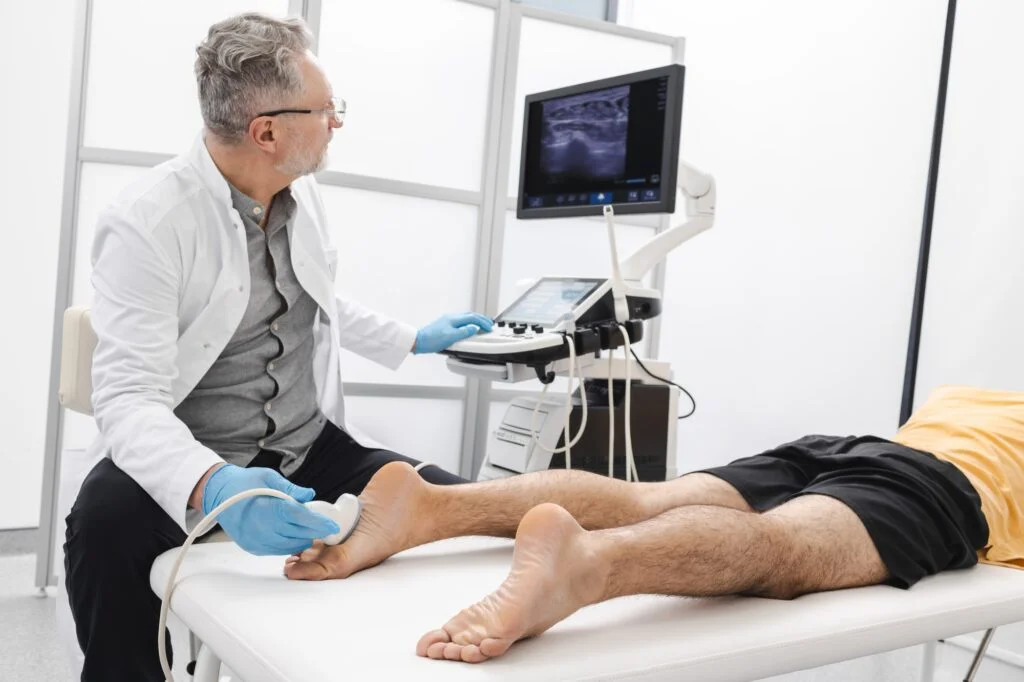
Diagnostic ultrasound is a non-invasive imaging technique that uses a special probe to take an image of your foot. The probe emits sound waves into your body tissues, which are returned to the probe and converted to an image used to diagnose and determine treatment for your foot condition. Ultrasounds can image the ligaments in your foot and ankle, plus the Achilles tendon, the plantar fascia, the posterior tibial tendon, and the peroneal tendons.
FX635 Laser is a Low-Level Laser Therapy (LLLT), sometimes referred to as a Cold Laser, used to address a variety of conditions including acute and chronic pain. Patients can expect no pain, no drugs, no side effects, and no downtime. LLLT alters cellular functions to reduce oxidative stress and increase the production of ATP, which fuels other cellular processes in the body.
Subchondral stabilization is a minimally invasive procedure used to treat subchondral bones, found beneath the cartilage, during the healing process. The subchondral bone acts as a shock absorber in weight-bearing joints and can result in stress fractures if weakened. An MRI will identify edema, which can be the cause of microfractures and chronic pain.
If conservative treatments do not work, your podiatrist will discuss surgery with you. We always look for conservative means first, but when surgical intervention is needed, we work closely with our patients from evaluation through post-operative care. Contact our office to schedule an evaluation and learn which advanced options are right for you.
Surgical Options and Recovery
Precision Foot and Ankle Centers offers a variety of surgical procedures aimed at solving lower extremity pains and deformities. Foot surgery treats many conditions including bunions, hammertoes, fractures, heel pain and plantar fasciitis, flat foot, metatarsal problems, ankle arthritis, Achilles tendon disorders, Morton’s neuroma, and tibialis posterior dysfunction. Minor procedures can be performed under local anesthesia in our office, while complex reconstructive surgeries are done in the hospital with mild sedation and local anesthesia.
Common procedures include bunion surgery to reposition the joint, fusions that join bones together with screws, plates, or pins to treat arthritis, and hammertoe surgery to realign the toe. Heel spur removal can restore mobility, and a plantar fascia release may be performed at the same time. Metatarsal surgery redistributes weight-bearing on the ball of the foot, and neuroma surgery removes the benign enlargement of the nerve to relieve burning, numbness, or tingling.
Our doctors were trained in some of the busiest trauma facilities in the country. We specialize in advanced reconstructive techniques with early mobilization and treat all types of foot and ankle trauma including fractures, tendon ruptures, and dislocations.
Each foot surgery requires unique after-care. At-home treatment generally includes RICE: rest, icing, compression, and elevation. Splints, casts, surgical shoes, and bandages may be necessary. Following surgery, our foot surgeons will provide detailed instructions to help the foot heal without complications so you can return to the activities you love.
Related Services
Find Advanced Care Near You
Precision Foot and Ankle Centers offers advanced treatments and procedures at convenient locations.
Ready to explore advanced options for lasting foot and ankle relief?
We’ll help you find the right treatment and get you back to what you love.