
Bunion Surgery That Corrects the Cause
Advanced bunion correction that realigns the bone, reduces recurrence, and gets you walking again quickly.
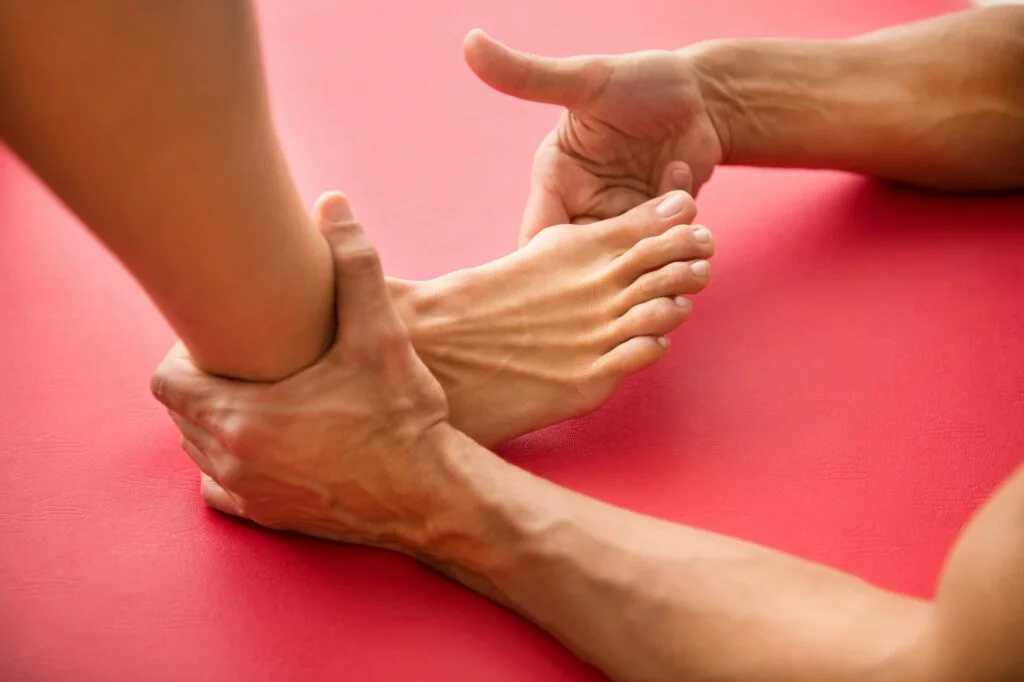
What You Need To Know About Bunions
Understanding what a bunion really is and when surgery becomes the right option.
Bunion Surgery at Precision Foot and Ankle
For most, a bunion is defined as a prominence or bump near the big toe joint. When seen with the naked eye, we don’t get the whole story. The bump that develops over time is the result of the slow drifting of a bone in the foot that in essence causes a dislocation of the big toe joint. The bump is, in fact, normal bone (not extra) in most cases that has moved out of position.
The cause of a bunion is biomechanical. Several foot structures can result in a bunion, and in many cases, instability of a joint along the arch causes the slow drifting of one of the bones comprising the big toe joint. The structure of your foot is determined by genetics, so many people suffering from bunion pain inherited a predisposition to develop one. Despite what you may read online, bunions are not caused by shoes, though tight or narrow shoes can irritate them.
Symptoms may include a callus or bump at the base of the big toe, pain, swelling or redness, callus under the ball of the foot, developing hammertoes, corns where the first and second toes overlap, and restricted big toe motion.
Having a bunion does not by itself require surgery. Bunion surgery is elective, meaning it is your choice whether surgery is the right solution. A bunion should be bothersome regularly to a point that limits your activities and shoes to be worth the risks and recovery involved. If your bunion is affecting daily life, we invite you to schedule an evaluation.
Our Approach to Bunion Correction
Correcting a bunion has evolved over decades. Long ago, the bump of bone was simply removed to reduce the painful prominence. This could provide short-term relief, but the instability at the root cause was not addressed. Later, surgeons shifted to repositioning the drifted bone through an osteotomy, cutting the bone and securing it with screws, pins, or plates. This improved alignment but often corrected the deformity in only one or two dimensions.
3D bunion correction repositions the bone to restore more normal anatomical function and motion in the great toe joint. Once the bone is corrected, the previously unstable joint is secured with plates, screws, and pins to provide a solid construct that minimizes recurrence. Lapiplasty and Lapifuse are two systems used today that support this approach.
For patients who prefer to avoid permanent metal hardware, OSSIOfiber offers an all-natural, metal-free implant built from natural mineral fibers and polymer. It provides strength during healing and is gradually replaced by your own bone over 18 to 24 months.
Our doctors perform advanced and precise surgical techniques. Most patients return to shoes three weeks after surgery unless the deformity is severe. Our recurrence rate is less than 5%, and more than 80% of our patients only require Tylenol or Advil for mild post-operative pain control. We typically use screw fixation, allowing early range of motion exercises so you can return to full activity quickly.
Where to Find Bunion Care Near You
Precision Foot and Ankle Centers offers bunion surgery at convenient locations near you.
Ready to stop letting bunion pain dictate your shoes and activities?
We’ll help you understand your options and find the right path forward.